
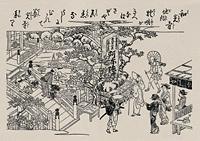
“Naniwa no nagame”(A view of old-time Osaka), Wako-ji Temple
Originally, Horie was the least developed swampy area in old Osaka. Bordered by the waters of the Nagahori Canal to its north, the Nishiyokobori Canal to its east, the Dotonbori Canal to its south, and the Kizu River to its west, the roots of the district first occurred in the very early Edo period. The development was concentrated on the riverside and the inland area was left untouched for a while until Kawamura Zuiken built the Horie Canal that runs through the center and Wako-ji Temple was established in 1698(Genroku11) in a newly developed quarter named Horie Shinchi (new land). Amida-ike(Amida Pond) is located in the spacious grounds of the temple.
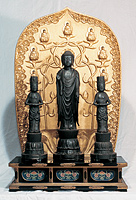
“Dozo Amida-sanzon Ryuzou” (standing bronze statues of Amida-sanzon),
Wako-ji Temple
The name of the pond is derived from a legend of an ancient statue of Amida (Amitabha) Buddha, which is believed to have been brought to Japan from Baekje (ancient Korea) in the 6th century. The statue was once disposed of in the pond during the anti-Buddhism movement but was recovered by a man named Honda Yoshimitsu, who took the statue back to his home in Shinano (today’s Nagano Prefecture) and later dedicated it to local Zenko-ji Temple. Based on this legend, a Buddhist monk, Chizen, regarded Horie as a holy place and established Wako-ji Temple. The image of the temple’s deity, which is Amida Buddha, is housed in a hall that floats on the pond. The temple has been affectionately called “amida-ike-san” by local people and has been a place of worship for them since.
To collect funds for investment in the development of Horie, the Edo Shogunate gave a variety of priorities to the district to encourage local businesses, by permitting shipping licenses and allowing the opening of markets, for example. The district evolved as the lumber industry flourished on the riverside of the Nagahori Canal, which became known as Zaimokuhama and served as the nation’s trading center of lumber. By the end of the Edo period, related manufacturing industries of furniture, Buddhist articles, and ranma (wooden decorative transom) were also established. During the Edo period, making a visit to a temple was one of the few leisure activities available to the common people. Unlike today, in which a variety of entertainment and amusements are available, people of those days had only limited recreational choice and visiting temples therefore was a rare and important occasion for them to satisfy their spiritual needs, enjoy a break, and relieve themselves from daily stresses. Temples at that time were not only the place of worship but also the destination for leisure.
Temples also tried to attract more visitors in various ways. At Wako-ji Temple, both inside and outside of its grounds were filled with entertainment stages, game arcades, show tents, and street vendors. Its lottery and plant fair also became popular. It was as if parks, theaters, and museums were all located within the temple. Wako-ji Temple gradually became the local center of entertainment.