
Last November, a world-first occurred when Osaka University produced a play entitled, “Hataraku Watashi” (I Am a Worker). This play featured two robots. The cast of this short 20-minute production included two human actors and two communications robots, the robots appearing under the combined stage name of wakamaru.
The play’s setting was the living room of the home of a young married couple, Yuji and Ikue. These protagonists cohabitated with two robots, named Takeo and Momoko. While Momoko, as a devoted cook, had become an important member of the household on whom everyone relied, Takeo had trouble finding any motivation to work. As the plot unfolded, it became apparent that Yuji was suffering from a similar malaise. By depicting such robot partners as a normal part of everyday life, the story suggested to the audience that not only human-to-robot, but also human-to-human, and robot-to-robot communications will play key roles in future lifestyles.
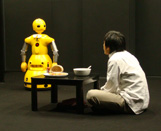
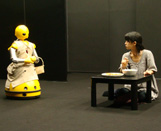
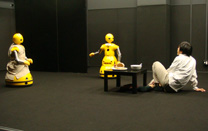
The play was written and directed by Oriza Hirata, an established playwright and producer who also teaches at Osaka University. Hirata’s productions are characterized by dialogues that are presented as a series of unconnected daily scenes. By developing the plot in such a matter-of-fact way, his plays gradually reveal certain themes that Hirata intends to highlight. In “Hataraku Watashi,” Hirata aimed to depict a fictional irony. Namely, that robots, made to function for some specific purpose, are faced with a dysfunctional dilemma resultant from the intelligence and personalities they are given.
With his directional skills and techniques, Hirata magically makes the audience believe that robots have both feelings, and the ability to express their innermost thoughts. With regard to how this illusion was created in the current production, it was necessary to create a gap between the dialogues exchanged by characters and the following actions that they carried out. As a director, Hirata can be extremely particular, asking his acting-charges to pause “0.3 seconds longer” when delivering their lines, or asking that they move “35 centimeters to the right.” However, by defining the positions, actions, expressions, and pauses of his protagonists, and other elements, Hirata has been successful in adding a certain perceptual reality to his plays. In the case of “Hataraku Watashi,” he has transformed emotionless robots into “living and breathing” actors. Hirata’s directing style has often been compared with the techniques employed by joruri puppeteers, who have the ability to manipulate puppets and make them come alive.
In creating the world’s first robotic actors, Professor Hiroshi Ishiguro of Osaka University’s Department of Adaptive Machine Systems served as the chief technical advisor. Globally recognized for his research and development of androids (robots that appear and behave like real humans), Professor Ishiguro has also been working on the development of humanoid robots that have the ability to interact with humans.
For the “Robot Theater” project, Professor Ishiguro focused on eliminating the awkwardness that people may experience when interacting with robots. Professor Ishiguro believes that no matter how much robotic performance is enhanced, there still exists a difficulty in developing a comfortable relationship between robots and humans as long as humans feel that robots being part of their daily lives represents somewhat of an oddity. Instead, in working on the current play, Professor Ishiguro felt his goal was to induce in his robotic protagonists natural actions and movements such as gesturing, posing between actions, and listening and responding to the stimulus of others. He felt that through such developments, the audience would be able to draw a more practical and explicit picture of how it was possible for humans to interact with robots.
Kazunari Kuroki, Chairman of Eager, a computer software development firm, served as a robots director for the production. He was also a producer. Kuroki was the person who originally envisioned the project, asking both Hirata and Ishiguro to partner with him in bringing it to reality. Furthermore, he and his company worked on the development of a program for the project, which required almost two years to complete. While hoping that robots become a common part of daily life in the near future, Kuroki is also ambitiously planning to develop “Robot Theater” as key element of future Osaka tourism. “My goal is to start the theater as a business next year. I also want to be holding performances outside Japan within five years.”
Although robotic technology continues to both develop and attract public attention/expectations regarding its development as a next-generation industry, the actual robotics business is still very much in a growth phase. While demand for industrial robots has resulted in the establishment of a large market, due to the ability of robots to replace human labor in tasks that are dangerous, demanding, overly-detailed, or otherwise difficult, in other fields such as entertainment (bipedal walking robots, animal robots), daily life (communications robots, ubiquitous robots), medicine and education, there is still the need to discover what potential demand exists.
In summary, the first performance of “Robot Theater” has illustrated some major challenges that still exist with regard to this new style of performance art. These challenges include expanding theatrical performance possibilities, lowering any resistance that humans feel towards robots, and exploring potential robotic business opportunities beyond just selling robots as a product. These are challenges that the theater experience expects to confront.
“I think a sunset looks prettier when you see it with someone you like” (Momoko) “But we have not progressed to that level as yet of feeling” (Takeo)